How GTE Localize generated 100+ meetings by shifting from email outbound to intent-driven LinkedIn outreach
Overview
GTE Localize helps global companies scale their localization programs across content, products and international markets.
With approximately $2.5M ARR and a growing presence in North America, the company relies heavily on relationship-building through its community and podcast, Local Reset, led by VP North America Matt Grotenstein.
But like many B2B companies, GTE Localize faced a growing challenge: traditional acquisition channels were becoming less effective.
Email deliverability continued to decline, paid acquisition produced diminishing returns, and manual LinkedIn outreach was difficult to scale.
The team needed a more predictable way to identify and engage high-intent prospects.
The challenge
Before Gojiberry, growth primarily came from:
• Referrals and word-of-mouth
• SEO and PPC campaigns
• Cold outbound email
• Manual LinkedIn prospecting through Sales Navigator
Historically, these channels had performed well.
But over time, things changed.
Email response rates dropped significantly due to deliverability issues and changing buyer behavior. Prospects became harder to reach through traditional channels, while LinkedIn increasingly became the platform where business conversations actually happened.
At the same time, manual LinkedIn prospecting created new challenges:
• Prospect discovery was time-consuming
• Outreach execution was inconsistent
• Sales Navigator workflows required significant manual effort
• Community engagement and podcast visibility were difficult to translate into pipeline
As Matt, the CEO explains:
"Business conversations moved to LinkedIn. Email became noisy and less effective."
The team needed a way to identify buying intent before reaching out.
The solution
GTE Localize implemented Gojiberry to build an intent-based LinkedIn acquisition system.
Instead of targeting large static prospect lists, the team focused on buying signals.
Specialized agents continuously identify prospects who are:
• Engaging with competitors
• Following industry influencers
• Participating in relevant conversations
• Matching their ideal customer profile
These prospects are automatically routed into multi-step LinkedIn campaigns combining:
• Connection requests
• Personalized messages
• Follow-ups
• Voice notes and video messages
• Email touches when relevant
A key feature prevents overlap between automation and sales reps:
Exit on reply.
As soon as a prospect responds, automation stops and the conversation becomes human.
Signals tracked
The team uses Gojiberry to identify prospects who:
• Engage with competitors
• Follow industry influencers
• Interact with localization-related content
• Match specific ICP criteria
• Show activity relevant to international growth initiatives
Rather than searching manually inside Sales Navigator, prospects are continuously surfaced through automated intent agents.
The workflow
GTE Localize built a simple but scalable process.
1 — Detect intent signals
Specialized Gojiberry agents continuously monitor LinkedIn activity and identify prospects matching their ideal customer profile.
2 — Launch multi-touch campaigns
Qualified prospects automatically enter outreach sequences including:
• Connection requests
• LinkedIn messages
• Follow-ups
• Voice notes
• Video messages
• Email touches when appropriate
3 — Human takeover on reply
A critical component of the workflow is automation control.
The moment a prospect responds, automation immediately stops and the conversation becomes human.
This prevents collisions between sales reps and automation while preserving authentic conversations.
Rhet describes the process as: "Automate everything you would normally do manually on LinkedIn."
Results
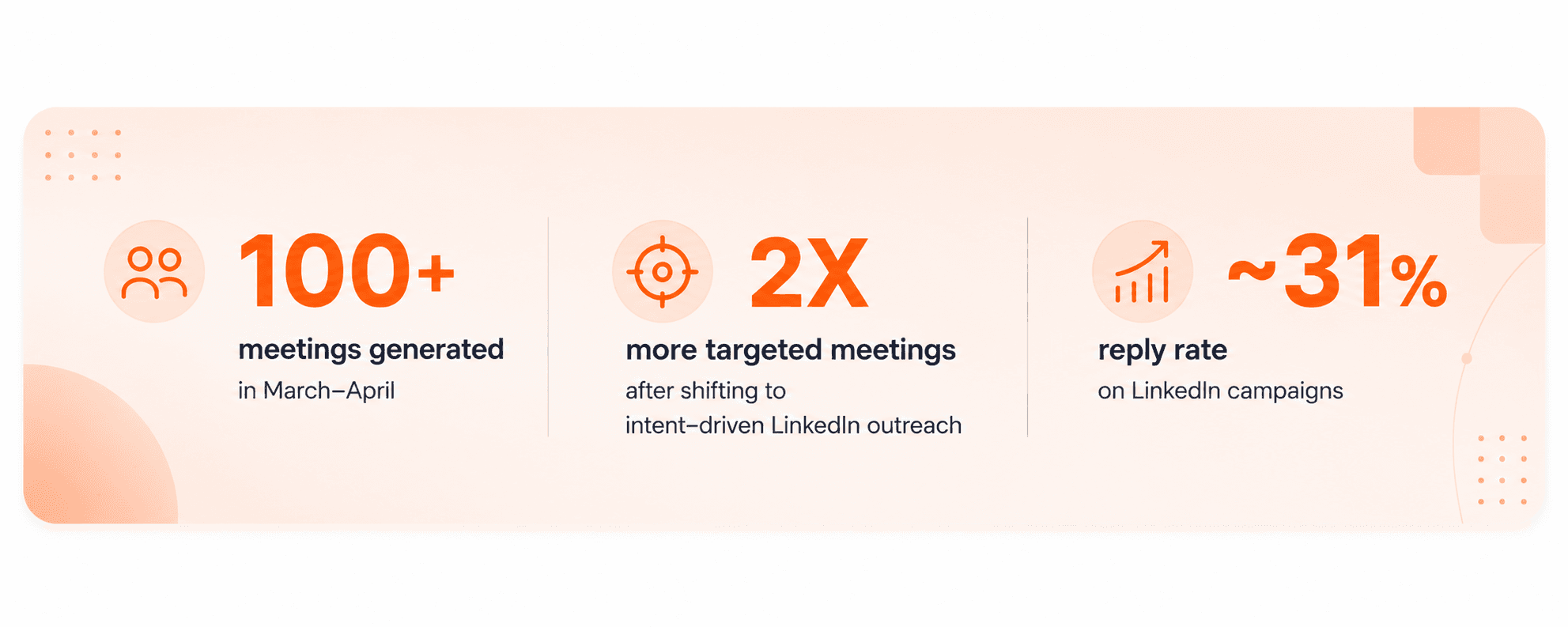
After implementing Gojiberry, GTE Localize generated more than 100 meetings during March and April alone.
Beyond meeting volume, the team also saw:
• Significant growth in brand visibility
• Increased engagement around the Local Reset podcast
• Better targeting of high-value accounts
• Reduced manual prospecting workload
• More predictable LinkedIn pipeline generation
Interestingly, while total meeting volume later decreased, meeting quality improved significantly as the team refined its targeting strategy and moved upmarket.
One key lesson emerged: Precision beats volume.
As Matt summarizes: "Sniper beats shotgun."
Why it works
For GTE Localize, the difference is timing.
Traditional outbound starts with a list.
Intent-driven outbound starts with a signal.
Instead of contacting thousands of prospects with no indication of interest, the team engages professionals who are already demonstrating relevant behavior.
This allows GTE Localize to:
• Start conversations when interest already exists
• Focus sales efforts on higher-quality opportunities
• Scale outreach without increasing headcount
• Turn LinkedIn into a predictable acquisition channel
Most importantly, the process aligns naturally with their community-first approach.
The objective isn't to push prospects into a sales conversation.
It's to start relevant conversations with the right people at the right time.
Product experience
Before choosing Gojiberry, the team evaluated several alternatives.
These included:
• Sales Navigator + manual workflows
• Apollo
• HubSpot sequences
• SuperSend
• Done-for-you services such as ListKit
According to GTE localize, Gojiberry provided the best balance between automation, flexibility and cost.
The ability to combine intent detection with automated LinkedIn workflows was a key differentiator.
What's next
GTE Localize plans to continue expanding its intent-driven growth model.
Future initiatives include:
• Refining ICP targeting
• Improving campaign performance
• Scaling community-led acquisition
• Connecting podcast engagement more directly to revenue generation
The team is also exploring additional optimization and consulting support to maximize performance across their campaigns.
The long-term goal is clear:
Build a repeatable growth engine where intent signals, LinkedIn outreach and community engagement work together to generate pipeline consistently.
The takeaway
Many B2B companies are experiencing the same challenge:
Email is becoming harder, paid acquisition is becoming more expensive, and traditional outbound is producing diminishing returns.
GTE Localize solved this by shifting from list-based prospecting to intent-based LinkedIn outreach.
By combining buying signals, automation and human conversations, the company generated more than 100 meetings in two months while building a scalable and repeatable acquisition process.
As Matt concludes:
"LinkedIn becomes much more strategic when you're targeting people who are already showing intent."

Your next 10 customers are already out there.
Let your agent find them.
Free Trial · Live in 5 minutes · Cancel anytime