Saleshandy review 2026: my honest take (after testing it)
Romàn
Saleshandy is a cold email platform. You plug in your mailboxes, load a list, build a sequence with follow-ups, and it sends. Since its 2026 pricing change it also bundles a contact database called Lead Finder, so you can pull prospects and email them on one subscription.
It's built for people who want outbound to be cheap and fast to set up. Freelancers, founders doing their own prospecting, small sales teams where email is the main channel. On that job it's one of the better buys at the price.
This review keeps circling a different question. Sending more email is a solved problem in 2026. Working out which twenty people on a list of two thousand deserve a message isn't solved, and no sending tool decides it for you.
30-second check
Do you need a better sender, or a better list?
No email required.
QUESTION 1 / 3
What slows your outbound down today?
QUESTION 2 / 3
How does your list get built?
QUESTION 3 / 3
Who runs the sending?
🎯
Your list is the bottleneck
A cheaper sender won't fix this
You're not short on sending capacity, you're short on a reason to write to any particular account this week. That's the part we work on.
- More than 30 buying signals watched across socials and the web
- Accounts that moved recently, surfaced with the reason attached
- The first message drafted against the signal
Retake the quiz
📧
Sending is the bottleneck
Saleshandy will do this job
You have the list and you need volume, rotation and follow-ups that don't break. Saleshandy is a fair call at that price. If the replies stay flat, the list is the next thing to look at. That's our half of the job.
- Unlimited mailboxes on every Saleshandy tier
- Follow-ups and variants without a per-seat charge
- Signals to decide who lands in the sequence next month
Retake the quiz
🏢
You're past this review
Look at a sales engagement suite
With a dedicated team and someone owning tooling, you'll want deep CRM wiring and rep coaching, which is a different category of product. Come to us instead for the half those suites leave out, deciding which accounts are worth the cadence.
- Signal-based account selection ahead of the cadence
- Flat team pricing rather than a per-seat contract
- Live in an afternoon, with no implementation project
Retake the quiz
Who's in market right now?
Gojiberry watches more than 30 buying signals across socials and the web, then hands you the accounts already looking for what you sell.
Find warm leadsTable of contents
Is Saleshandy worth it?
Yes, if you need a cold email tool and you already know who you're emailing. It's easy to learn, the sequence builder does what you'd expect, and $34 a month on annual billing buys a lot for the money. For a two to ten person team where email carries the pipeline, it holds up.
It's a weaker call if your problem sits upstream. When you're unsure which accounts to contact, a better sending engine doesn't move the number you care about. That gap is where most of this review lives.
How I tested Saleshandy
I ran the seven-day trial on my own domains, connected two mailboxes, built a three-step sequence with follow-ups, and pulled a small list out of Lead Finder to see what the data looked like. Every price in this article comes from the Saleshandy pricing page and was checked on September 3, 2026, add-ons included. We pay for the tools we write about, and no vendor read a word of this before publication.
What you won't find here is a scorecard of measured reply rates or inbox placement. I haven't run a controlled send across several platforms on one identical list, and a made-up percentage would be worth less than this sentence admitting it. When we run that test, the numbers land on this page. One disclosure to get out of the way: Gojiberry is our own product, and our client results sit in full on the case study hub.
What is Saleshandy?
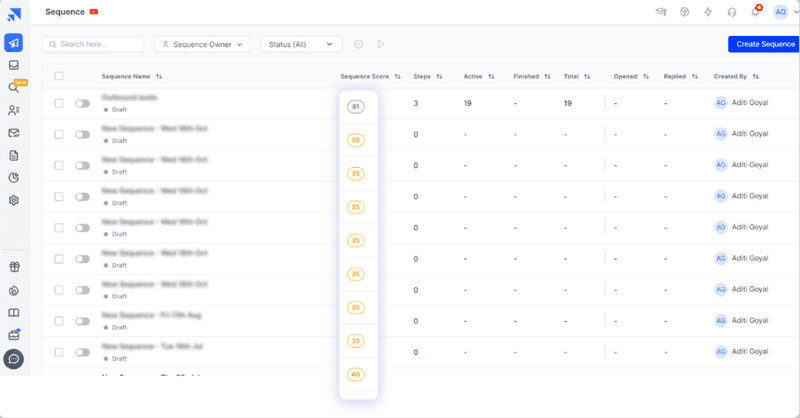
Saleshandy is a cold email and outreach platform. The core of it is the sequence engine: you connect as many mailboxes as you like on any plan, rotate sends across them, and run multi-step follow-ups that stop the moment someone replies.
Around that sit the pieces most teams would otherwise buy separately. Lead Finder is now included on every plan, with 1,500 to 8,000 credits a month depending on the tier, drawing on a database of 852 million contacts. One credit reveals a verified work email and six reveal a mobile number. Warm-up, email verification, a unified inbox for replies and CRM integrations come with the subscription.
There's a calling add-on and a light CRM view, and a sequence can hold manual tasks and call steps next to the email ones. Email is still the center of gravity, and everything else orbits it.
What I like about Saleshandy
- 🧩 Setup you can finish in an afternoon. Connect a mailbox, import a CSV, write three steps, pick a schedule. No onboarding call stands between you and a live campaign.
- 🔁 Sequences that cover the basics properly. Multi-step follow-ups, A/B variants, and subsequences on Pro that branch depending on how someone replied.
- 💰 A price a small team can sign off without a meeting. Starter runs $34 a month when you pay for the year. Pro covers up to ten users at $76, with no per-seat charge on top.
- 📧 Unlimited mailboxes on every tier. Plenty of competitors cap connected inboxes or bill you per inbox, and that bill grows exactly when your sending does.
Where Saleshandy falls short
Two limits, and they're different in kind. The first is a scope choice you can live with. The second decides whether the tool solves your problem at all.
What happens when email is the only channel?
Saleshandy will drop calls and manual tasks into a sequence, and there's a dialer add-on at $23 to $55 a month. What it won't do is run a genuine multichannel motion across the social channels where a lot of B2B conversations now start. If email is your channel, fine. If you want a prospect touched in three places over two weeks, you'll be stitching tools together and paying twice.
There's also a ceiling on the send-more strategy. Google holds bulk senders to a spam complaint rate under 0.3%, and the quickest route across that line is a well-written email sent to people who never asked for it. Volume without targeting has a price, and it lands on your domain reputation rather than your invoice.
Is a contact the same thing as a prospect?
Lead Finder hands you an email address that resolves. Whether the person behind it is in the market this quarter is a separate question, and the database can't answer it.
B2B contact data decays at roughly 2.1% a month, close to 22% across a year, so a list you built in January is meaningfully wrong by summer. Verification catches the bounces. It won't tell you that a company just opened a role you sell into, or swapped out a tool in its stack.
That's the split. Saleshandy helps you contact prospects. Gojiberry works on which prospects deserve contacting in the first place, by watching signals across socials and the web and surfacing the accounts that moved this week. Mindflow lifted its outbound reply rate 31% by triggering on the signal instead of the list, and the write-up is here.
Stop guessing who to contact
Find prospects showing real buying signals before you reach out.
See the signalsSaleshandy pricing
Three published plans plus a custom Enterprise tier. Annual billing knocks roughly 30% off the monthly rate, and the figures below were taken from the pricing page on September 3, 2026.
For what's in the box, that reads fair. Starter gives you 2,000 active prospects, 6,000 emails a month and 1,500 lead credits, which is enough to find out whether outbound works for you at all. Pro is where most teams settle, at 30,000 active prospects, 100,000 emails and 4,000 credits a month.
What a team of three pays
The subscription isn't the whole bill. Mailboxes are an add-on at $2.99 to $3.99 each per month and domains cost $14 a year, so a three-person team on annual Pro with twelve mailboxes and three domains lands near $115 a month against a $76 sticker. Still inexpensive for this category. Budget from the setup you'll be running rather than the banner price.
Saleshandy vs Gojiberry
People compare the two because both end with an email in somebody's inbox. They start from opposite ends of the same motion.
Saleshandy is about reaching prospects. It gives you the database, the sequence engine and the deliverability plumbing, then leaves the targeting call to you. That's a reasonable division of labor when you know your market cold.
Gojiberry starts a step earlier. It watches for the moments that make an account worth writing to, a hiring signal, a tool change, a funding round, and hands you the account with the reason attached. Same channel, different question answered.
Job moves are the clearest case. Median US job tenure runs 3.9 years, and about 22% of employees have been in post under a year. On any list you own, a slice of your buyers changed seats and nobody sent you a memo.
60%
of Wispra's weekly demos now come from intent signals rather than list-based outbound.
100+
meetings booked at GTE Localize after moving off email blasts to intent-led outreach.
2x
network growth at Baur Software by scaling outreach that still read as personal.
Saleshandy vs other alternatives
Should you pick Lemlist instead?
Lemlist costs more and does more with it. The personalization work and the multichannel steps are further along, so it earns the premium when your messages carry images, custom pages or several channels. Saleshandy is the simpler and cheaper tool, and for plain email sequences the gap narrows fast. Our full take sits in the Lemlist review.
Should you pick Instantly instead?
Both are strong at the same job, and choosing between them comes down to workflow rather than capability. Instantly's inbox management has its fans, while Saleshandy bundles more contact data into the base plan. Neither one tells you who to write to. There's a longer breakdown in the Instantly review.
Is Saleshandy worth it in 2026?
SALESHANDY MAKES SENSE IF
- 🧰 Cold email is the channel that carries your pipeline
- 👥 You're a team of two to ten with nobody owning ops
- 🚀 You want to be sending this week, not next quarter
- 🧮 Price is a real constraint on the decision
- 📌 You already know which accounts you're targeting
LOOK ELSEWHERE IF
- 🔀 You need outreach running across more than one channel
- 🔎 Your bottleneck is finding qualified prospects
- 🔔 You want buying signals deciding who gets contacted
- 📅 You want the timing set by what the buyer just did
- 📊 Your replies stayed flat while your volume climbed
So: worth it, inside a boundary. As a sending tool for a small team, Saleshandy is one of the best value options on the market this year. As an answer to who should be receiving those emails, it isn't one, and no amount of extra sending capacity turns it into one.
Why we built Gojiberry
Before Gojiberry there was Coco.ai, and Roman spent his days prospecting on socials for it. He'd check who had changed jobs, who was hiring, who had just posted about a problem we solved, then write to those people by hand. The messages that worked weren't better written, they were better timed.
Doing that manually caps out around thirty accounts a week, and it dies the moment you're busy closing. So we built the watching part into software and kept the writing human. Coco.ai was the training ground, and everything we got wrong there is why the signal comes with a reason attached instead of a score.
Questions people ask about Saleshandy
How much does Saleshandy cost?
Starter is $34 a month billed yearly, or $41 month to month. Pro is $76 annual or $99 monthly, and Scale is $149 annual or $189 monthly. Enterprise is quoted on your volume. Mailboxes, extra credits, the dialer and inbox placement testing sit outside those figures, all checked September 3, 2026.
Is Saleshandy good for cold email?
Yes. It's the strongest thing the product does. Small teams running straightforward outbound get unlimited mailboxes, sender rotation, warm-up and follow-ups without a per-seat bill. If you need something to load into that sequence, we keep a set of cold email templates that still get replies.
Does Saleshandy have a lead database?
It does. Lead Finder comes with every plan and covers 852 million contacts and 42 million companies, filtered by title, seniority, industry, headcount, location and tech stack. You spend 1 credit per verified email and 6 per mobile number, and unverified results cost nothing. Monthly allowances run 1,500 on Starter, 4,000 on Pro and 8,000 on Scale.
Does Saleshandy have buying intent data?
Not in a meaningful sense. The filters include hiring signals and firmographics, which help you describe a segment, and that's contact data rather than intent. Intent is behavioral: a company adding roles you sell into, changing a tool, raising money, publishing something that reveals a problem. Gojiberry tracks more than 30 of those signals and surfaces the account while the moment is still live.
What is the best Saleshandy alternative?
Depends what's broken. Lemlist if you want deeper personalization and multichannel sequences and you'll pay for them. Instantly if you want a comparable sender with a different interface. Gojiberry if the sending already works and the targeting doesn't, since we pick the accounts and the timing before anything gets written.
Does Saleshandy have a free plan?
No permanent free tier. There's a seven-day trial with no card required, capped at 100 sent emails, 2,000 prospects and 50 lead credits. That's enough to judge the interface and the data quality, and not enough to judge deliverability.
Can you run Gojiberry and Saleshandy together?
That's the pairing that makes sense. We decide which accounts moved and why, Saleshandy carries the delivery at volume. Wispra now sources 60% of its weekly demos from signals rather than a static list, and there's a full set of client results if you want the detail.
Ready to find warmer leads?
Find companies that are already looking for what you sell.
Try Gojiberry See the results first
Your next 10 customers are already out there.
Let your agent find them.
Free Trial · Live in 5 minutes · Cancel anytime